

Modern Smart Home Automation Ideas for 2026
Table of Contents
- What Modern Smart Home Automation Looks Like in 2026
- AI Smart Home Automation Trends 2026: From Reactive to Predictive
- Core Smart Home Automation Ideas for Every Room
- Best Smart Home Devices for 2026: What's Worth Your Money
- Beginner-Friendly Smart Home Automation: A Simple Start
- Retrofitting Older Homes and Future-Proofing with Matter
- Protecting Your Privacy and Data Security
- Conclusion: Building a Smart Home That Adapts to You
- Frequently Asked Questions
Last Updated: September 8, 2026
What Modern Smart Home Automation Looks Like in 2026
Modern smart home automation is the integration of sensors, connected devices, and intelligent software that anticipates your needs and acts without manual input. The era of controlling individual gadgets from separate apps is over; the focus has shifted to predictive automation that learns your routines and adjusts your environment accordingly. The 2026 landscape is defined less by product novelty and more by seamless cooperation.
The most significant change this year is the maturity of interoperability. Unified standards mean your lighting, thermostat, and locks can finally communicate regardless of manufacturer. This guide covers the specific ideas, devices, and system architectures that deliver real value, helping you avoid buying gadgets that do not integrate into a cohesive ecosystem.
AI Smart Home Automation Trends 2026: From Reactive to Predictive
The defining trend for 2026 is the transition from rule-based automation to context-aware intelligence. Rather than simply executing "if this, then that" commands, AI smart home automation trends 2026 use on-device machine learning to analyze patterns in occupancy, energy usage, and daily schedules, enabling nuanced decisions like pre-cooling the bedroom based on your sleep cycle data.
This shift relies heavily on advanced presence detection. Traditional motion sensors are being replaced by mmWave sensors that distinguish between a human, a pet, and an empty room with high accuracy, reducing false triggers and enabling sophisticated routines. The focus is on energy efficiency and seamless user experience.
How On-Device AI Differs from Cloud-Based Processing
A critical distinction in 2026 is where the intelligence lives. Cloud-based AI offers more processing power and aggregate learning but introduces latency and privacy questions. On-device AI runs entirely on a local hub or within the device, delivering faster response times, critical for security, and ensuring routines continue working if your internet drops. A hybrid approach often works best: on-device AI for time-sensitive automations, cloud processing for complex tasks like voice recognition or long-term energy trend analysis.
Real-World AI Automation Patterns
Here are three automation patterns that demonstrate the shift from reactive to predictive:
-
Adaptive Wake-Up Routine: Instead of a fixed alarm, your bedroom lights begin a slow sunrise simulation 30 minutes before your typical wake time, based on sleep data from a connected mattress sensor or wearable. The thermostat adjusts to your preferred morning setting, and your coffee maker begins brewing when the system detects you have gotten out of bed.
-
Energy Arbitrage with Time-of-Use Rates: Many utilities offer time-of-use pricing, where electricity costs more during peak hours. An AI-driven energy management system learns your utility's rate schedule and automatically pre-charges your EV or heats your water heater during off-peak hours, adjusting the charging window to your driving habits to ensure sufficient range while minimizing cost.
-
Context-Aware Security Response: A predictive system learns the difference between a delivery driver approaching your porch at 2:00 PM and an unknown person lingering near a side door at 11:00 PM. In the first case, it may simply log the event. In the second, it can trigger interior lights, send a push notification, and begin recording from multiple cameras.
The Role of Machine Learning in Energy Optimization
Energy optimization is where AI delivers the most measurable return. A learning thermostat analyzes weather forecasts, your home's thermal characteristics, and your absence patterns to pre-condition your home efficiently (energy.gov). On a hot summer day, it might start cooling at 3:30 PM rather than 5:00 PM, knowing your house takes longer to cool and energy rates spike later. This predictive approach can significantly reduce HVAC energy consumption compared to a standard programmable thermostat.
Core Smart Home Automation Ideas for Every Room
To build a practical system, think in terms of zones and the specific activities that happen in each space. The most effective smart home automation ideas solve a recurring annoyance or save you time daily. Instead of adding sensors everywhere, focus on high-traffic areas and the routines that happen there.
Smart Lighting and Climate Control
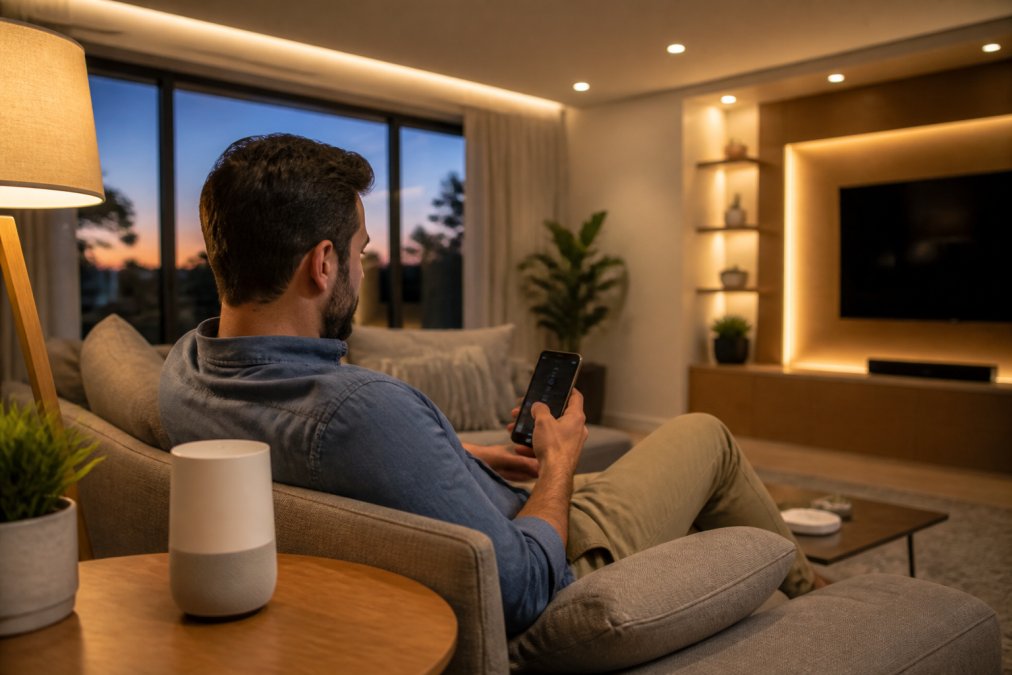
Smart lighting is the most accessible entry point into automation. Adaptive lighting adjusts brightness and color temperature to match the time of day and your activity, a "movie night" scene dims lights to 20% with warm tones, or a "focus" scene uses brighter, cooler light in the home office.
Climate control delivers the most significant energy savings. A learning smart thermostat builds a schedule based on your comings and goings, ensuring you are not heating or cooling an empty house. Integrating it with presence detection allows for "follow-me" comfort, prioritizing the climate in the room you occupy.
Security, Presence Detection, and Leak Sensors
A comprehensive automation strategy treats security as an active system. Smart locks can unlock automatically when you arrive home, while interior cameras begin recording and exterior lights brighten when no one is home, creating a layered defense that responds to your presence.
Water management is a critical, often overlooked, component of home automation. Leak sensors near water heaters, under sinks, and behind washing machines can detect early leaks and trigger a motorized shutoff valve, preventing thousands of dollars in damage. Real-time water usage monitoring can also alert you to running toilets or dripping faucets.
Best Smart Home Devices for 2026: What's Worth Your Money
Many buyers prioritize brand names over system compatibility. When evaluating the best smart home devices for 2026, your primary consideration should be the communication protocol they support. Devices supporting Matter and Thread offer the most reliable, low-latency communication across major platforms like Amazon Alexa, Google Home, and Apple HomeKit.
The Matter and Thread Advantage: Future-Proofing Your Investment
The single most important purchasing decision in 2026 is not which brand to buy, but which protocol standard to back. The Matter protocol, released in late 2022 and now in its second major revision, is a unified application layer allowing devices from different manufacturers to communicate natively (csa-iot.org). Thread is the underlying mesh networking technology Matter often uses, providing low-power, low-latency communication without Wi-Fi congestion (threadgroup.org).
A Matter-certified smart bulb purchased today will work with a Matter-certified hub from any major platform, Amazon, Apple, Google, or Samsung, and remain compatible with future generations. This is a fundamental shift from the pre-Matter era, where buying into the wrong ecosystem meant replacing your entire setup. You can now buy the best device for each category without worrying about ecosystem lock-in.
What to Look For in Each Device Category
| Device Category | Key Feature to Prioritize | Integration Protocol | Best For | 2026 Watch-Out |
|---|---|---|---|---|
| Smart Thermostat | Learning algorithm & occupancy sensor | Matter, Wi-Fi | Energy savings & comfort | Verify it supports your HVAC system's specific wiring (e.g., heat pump vs. conventional) |
| Smart Lock | Auto-unlock geofencing & tamper alarm | Matter, Thread | Security & convenience | Check if it supports Apple Home Key or similar NFC-based unlocking |
| Leak Sensor | Instant alert & auto-shutoff valve support | Matter, Zigbee | Water damage prevention | Ensure the sensor has a local siren, not just a phone notification |
| mmWave Presence Sensor | Human vs. pet detection | Thread | Precise automation triggers | Confirm the detection range covers your intended room size |
| Smart Bulbs | Tunable white & color temperature | Matter, Thread | Adaptive lighting scenes | Look for high CRI (90+) for accurate color rendering |
The Hub Question: Why Local Processing Matters More Than Ever
Focusing on a smart hub is often more valuable than buying more endpoints. A hub, such as an Apple TV 4K, Amazon Echo Show, or Homey Pro, acts as the central brain, allowing complex automations to run locally with lower latency and higher reliability. Local processing ensures critical automations like door locks and security cameras continue to function even if your internet goes down.
The 2026 landscape introduces a critical distinction: Thread border routers. These devices, often built into smart speakers, hubs, or Wi-Fi routers, allow Thread devices to communicate with your broader network. When you buy a Thread-enabled device, you need at least one Thread border router in your home for it to function. Most major smart speakers include this capability, but verifying before purchase can save you from a frustrating setup.
The Cost of Ignoring Interoperability
A common pattern among frustrated smart home owners is the gradual accumulation of devices from different ecosystems that do not communicate. You might have a Nest thermostat that only works with Google Home, Philips Hue bulbs that require their own bridge, and a Ring doorbell that insists on its own app. The result is a fragmented system where you juggle multiple apps and cannot create cross-device automations. The financial cost is not just the devices, it is the lost potential for energy savings, security integration, and convenience. Prioritizing Matter and Thread from day one avoids this fragmentation.
A Practical Budget Allocation Strategy
A sensible budget allocation might prioritize systems that deliver the highest return on investment in energy savings and security.
Beginner-Friendly Smart Home Automation: A Simple Start
For those new to this space, the process can seem intimidating. Beginner-friendly smart home automation is about starting with a single, high-impact device and building from there. The goal is to solve one specific problem before expanding, making the learning curve manageable.
A common approach is to start with a smart speaker or display as your primary interface, giving you a central point for voice-activated control. From there, consider these incremental steps:
- Connect your existing entertainment system to the smart speaker for voice-activated control.
- Replace your most-used light switch with a smart switch for scheduling and remote access.
- Add a smart plug to a lamp or appliance in a room you use daily, like a coffee maker in the kitchen.
- Install a smart thermostat to begin automating your home's climate and start saving energy.
- Once you are comfortable, add a sensor-based trigger, such as a door sensor that turns on a hallway light when opened at night.
This progressive build-out ensures each addition is stable and understood before moving on. It also helps you identify which devices are essential versus unnecessary, saving money and reducing complexity.
Retrofitting Older Homes and Future-Proofing with Matter
One of the biggest concerns for homeowners is whether automation is possible in an older property without major renovations. Retrofitting older homes is not only possible but can be done without running new wires, thanks to wireless technology. The key is to prioritize battery-powered sensors and devices using wireless protocols like Thread, Zigbee, or Wi-Fi, avoiding the need to cut into walls.
When retrofitting, the most critical decision is choosing a future-proof standard. The Matter protocol is a unifying standard designed to ensure interoperability between devices from different manufacturers. By prioritizing Matter devices, you build a system less likely to become obsolete and able to integrate with future products, especially important in older homes where you may be replacing fixtures gradually.
Protecting Your Privacy and Data Security
As your home collects more data about your habits, privacy and data security architecture becomes a primary concern. The first step is a review of your network security: keep your router's firmware updated and create a separate network segment, often called a guest network, specifically for your IoT devices. This isolates them from your primary computers and phones, limiting potential damage if a device is compromised.
Data privacy extends to the devices themselves. When configuring a new camera or sensor, disable unused features and review the permissions it requests. Many devices offer local processing options where video or voice recordings are analyzed on the device rather than sent to the cloud. For sensitive areas like bedrooms, choose devices with physical privacy shutters or prioritize local storage over cloud subscriptions. Always change default passwords and enable two-factor authentication.
Conclusion: Building a Smart Home That Adapts to You
The common thread through all of these modern smart home automation ideas 2026 is a move toward systems that understand context. The goal is not to have the most gadgets, but to build an environment where technology anticipates your needs, enhances your comfort, and respects your privacy. By focusing on interoperability, starting small, and prioritizing security, you can create a smart infrastructure that truly adapts to your life.
Building this system does not have to be a chore. At Mayon Finds, we curate a selection of premium tech gadgets designed to integrate smoothly into a cohesive ecosystem, so you can avoid the headache of incompatible devices. Our focus is on quality and durability, ensuring your smart home setup works reliably for years. Explore our collection to find the devices that will simplify your daily tasks and create a home that responds to you.
Frequently Asked Questions
What are the key trends in smart home automation for 2026?
The biggest shift is from reactive commands to predictive automation. AI systems learn your routines and adjust lighting, climate, and music without prompts. Interoperability through the Matter protocol is also critical, allowing devices from different brands to work together on a single network. Energy management and proactive security alerts are other major trends shaping modern setups this year.
How do I start building a modern smart home ecosystem if I'm a beginner?
Start with a single smart speaker or hub as your foundation, then add one category at a time, beginning with smart lighting or plugs. These are easy to install and immediately show the value of automation. Build simple routines, like having lights turn on at sunset, before adding more complex sensors. This approach keeps the process manageable and helps you avoid the frustration of trying to connect too many systems at once.
Will my existing smart home devices work with new 2026 products?
Not always, which is why checking for Matter and Thread support matters. Matter is the new connectivity standard designed to make devices from different brands work together locally. If your current devices are Matter-certified, they will communicate with new hubs and controllers. Otherwise, you may need to use separate apps or upgrade older devices to achieve full integration.
What are the most energy-efficient smart home automation ideas?
Automated climate control is the biggest energy saver. Smart thermostats adjust temperatures when you are away or asleep. Smart lighting with occupancy sensors ensures lights are never left on in empty rooms. Smart plugs can cut phantom power draw from electronics. Using energy consumption metrics from these devices helps you identify the biggest drains and adjust your routines for greater efficiency.
What is the best way to retrofit an older home with smart home automation?
Focus on wireless solutions that do not require rewiring. Smart bulbs, plug-in outlets, and battery-powered sensors are ideal for older homes. Pay close attention to your home network stability, as older construction can interfere with Wi-Fi signals. A mesh network or a hub using the Thread protocol can provide more reliable coverage for devices in every room.
How does AI integration change smart home automation in 2026?
AI moves your home from following rules to anticipating your needs. Instead of a simple schedule, the system learns your patterns. For example, it might notice you usually lower the thermostat when you go to bed and start doing it for you. It also improves voice control and security, enabling it to distinguish between a resident and an unfamiliar presence.
The best smart home is not the one with the most features, but the one that works quietly in the background to make your life easier. Start with a single problem you want to solve, choose devices that speak the same language, and build your system with intention. Get started with Mayon Finds and build a smart home that truly adapts to you.